

Finding My Voice
On changing, growing, and why that’s not something you should have to apologise for.

When Metallica released The Black Album in 1991, a significant portion of their fanbase decided they were done. The riffs were cleaner. The songs were shorter. The production, helmed by Bob Rock, had a polish that the raw, blistering records of the 1980s deliberately avoided. To the diehards, all of this added up to one thing:
“They sold out.”
Thirty years later, they still haven’t forgiven them.

What makes this particularly worth examining is what actually happened next. The Black Album went on to sell roughly 17 million copies in the United States alone, and over 30 million worldwide. Hell, it spent four years on the Billboard 200. It is, by most commercial measures, the best-selling metal album ever made.
More than that, a large portion of the metal community including many who were there from the beginning, who bought Kill ’Em All on tape and stood in the pit for the Damage Inc. tour consider The Black Album to be Metallica’s finest work, including me.
The album that “sold out” became the definitive one. The album that supposedly betrayed everything turned out to be the one that outlasted everything. Funny huh?
None of that stopped the complaints, of course. Metal Hammer put together a list of eleven times Metallica were accused of selling out, and reading through it tells you everything you need to know about how this kind of criticism actually works. The accusations didn't start with The Black Album. They didn't even start with a song.
Number one on the list is a quote from James Hetfield's high school yearbook, where his stated career goal was simply "play music, get rich." The band hadn't released a record. They hadn't played a show. As far as some people were concerned, that was enough.
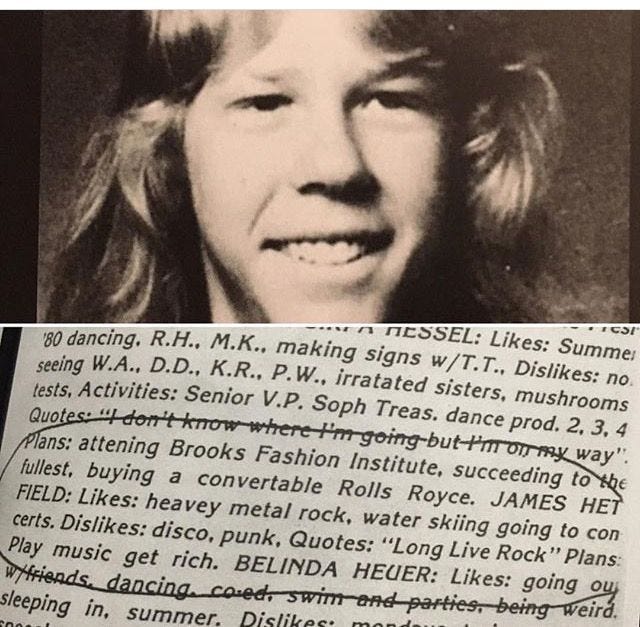
Dave Mustaine getting fired in 1983 made the list too, before Kill 'Em All had even been recorded. Then came the crime of making a music video. Then an acoustic guitar appearing on Ride the Lightning. Then, five years after The Black Album, cutting their hair for Load. The list keeps going and the further down you get, the clearer it becomes that none of this was ever really about the music. It was about people who had decided they owned something that was never theirs to own.
The anger makes sense. When something you love changes, of course you feel it. What doesn't make sense is treating change as a betrayal. The idea that the first version of something is the only real one, and that everything after is somehow fake, that's not a reasonable position. People grow. Bands grow. Moving forward isn't moving away from who you are. It's just what happens when you don't stand still.
The Gamble Nobody Talks About
Here’s what the sellout conversation almost always misses: The Black Album was not a safe move. It was a significant risk taken by a band that had no particular reason to take it.
Going into 1991, Metallica had no reason to change anything. And Justice For All had sold over two million copies. They were headlining arenas. The fanbase was loyal and growing. They had spent years building a reputation on thrash metal that was brutal, technical and completely uninterested in mainstream approval. It was working. Nobody was pushing them to do something different.
Stepping away from thrash meant stepping into a completely different fight. Traditional heavy metal already had its giants.
Dio.
Halford.
Geoff Tate.
Vocalists who had spent years reaching levels that Hetfield himself would be the first to admit he was never competing with. That was the new standard they were walking toward.
And there was still the old fanbase to think about. If the diehards felt abandoned and left, Metallica needed the new audience to fill that gap. But there was no guarantee those people would show up. What if they tried to cross over and ended up with nobody? It happens. Bands have made that exact mistake and never recovered.
The Black Album worked. The diehards mostly stayed, the new fans came, and a lot of those new fans went back and discovered the earlier records. But none of that was guaranteed going in. It could just as easily have gone the other way.
It’s Not Just How You Write
I am not the same person at 7am as I am at 7pm. Not in a deep, philosophical way. Just practically. How I think, the words I reach for, how much I trust myself in the moment, all of it moves around depending on sleep, what kind of day it has been, who I have spoken to, what is still sitting unresolved somewhere in the back of my head.
Most people are the same. The difference is that most people have learned to hide it. You show up the same way in the morning as you do in the afternoon because that is what is expected. Consistency reads as professional. Variation reads as unreliable. So everyone quietly agrees to paper over it and pretend the version of themselves they are presenting is the real, fixed one.
For me it is harder to hide, because I have a stutter. I have had it my whole life. I spent a long time being embarrassed by it. Now I find it more interesting than anything else, because it has shown me things about how communication actually works that I do not think I would have understood otherwise.
The stutter is not a problem with words. I know the words. The problem is the gap between thinking and speaking, that tiny moment where the brain has already written the sentence and the mouth is supposed to deliver it. My brain moves fast. It is usually several thoughts ahead before the first one has finished coming out.
The stutter lives in that gap, and how loud it is on any given day depends entirely on everything else going on. If I’m tired, stressed, or talking to someone unfamiliar? It’s there. If I’m relaxed, comfortable, talking about something I know and care about? It backs off a little. My speech tells you exactly where I am whether I want it to or not. There is no performing through it on a bad day.
Writing is where that changes. On the page I can think as fast as I want and take as long as I need. Nobody is watching. Nobody's face is doing anything while I work through a sentence. The page holds still and lets me catch up to myself. For someone who has spent their whole life in the gap between thinking and speaking, that matters in a way that is genuinely difficult to overstate.
The Writing Problem
All of this directly affects how I write and why my writing doesn’t always sound the same.
I spent years writing in the sports nutrition industry. Product writeups, formulation breakdowns, ingredient analysis, the science behind why something works and how much of it you actually need for it to do anything. It is a world where the writing has to carry real weight, because the people reading it are not casually interested. They have done their research. They know the ingredients, they know the studies, and they know when someone is dressing up weak evidence in confident language to make a sale. You can’t bluff your way through it, not for long anyway.
Every claim needs to hold up. Not just sound right, actually hold up. If it can’t, someone will notice. Competitors read everything and a weak argument or a claim will quickly be ripped apart by their reps. In that industry, your writing is your credibility. Let it slip and boy will you feel it.
So you develop a way of building sentences the way you would build a case. Start with what you can actually defend. Say it clearly. Do not add anything that does not have solid ground underneath it. It is a discipline that becomes a habit, and the habit sticks around even when the subject matter changes.
That discipline is genuinely valuable and I don’t want to lose it. It’s why I tend to put the most important information at the front rather than burying it three paragraphs in. It’s why I’d rather say something plainly than package it in language designed to sound impressive but actually say very little. Years of writing for an audience that would call out weak reasoning taught me to respect the reader’s intelligence without assuming their patience.
That kind of writing requires a specific headspace though. You have to be fully on. Patient enough to sit with a sentence until it says exactly what it needs to and nothing extra. That is not always available. Some days the clarity just isn't there, and trying to force that level of precision when your head isn't in it produces something stiff and lifeless. The words are all correct and the piece still goes nowhere.
The ability to write in that style, it’s not just a mental energy thing. That kind of writing has a research cost behind it too. You are not pulling this from memory. You are going deep into PubMed and ResearchGate, cross-referencing studies, and a lot of the full PDFs you actually need are locked behind paywalls. You are buying access to research just to do the job properly. That takes time, money and a level of focus that you can’t fake your way through on a slow day.
Not everything needs that approach anyway. Some writing is not trying to build an argument. It is trying to reach someone. Those are different goals and they need different versions of you. The way I write a technical breakdown and the way I write something personal or conversational are not going to sound the same, and they are not supposed to. It is not inconsistency. It is just using the right tool for what the piece actually needs.
Then there is the fact that English is not the language I grew up in. Greek was. And that changes things in ways that are hard to fully explain but easy to feel. When you grow up in a language you stop thinking about it. The words just come. When you learn a second language properly, as a conscious process, you never quite lose the habit of noticing. Even now I will hit a word and pause for a beat. Is this the right one or just the convenient one? Is this sentence actually saying what I mean or have I just borrowed something that almost fits? It slows you down sometimes. But it also means you rarely say something by accident.

Greek has its own rhythm too, one that does not translate directly but does not disappear either. It builds. Sentences stack ideas on top of each other, adding weight slowly before they finally land. I can feel that pull when I write in English. The instinct to hold something open a little longer, to let a thought develop before closing it off. Whether that actually comes through on the page the way it feels when I am writing it, I honestly could not tell you. But it is there, working underneath the surface before I have made any conscious decisions about structure.
Wait, Is This Just AI?
Here's something I may as well address directly. If my writing sounds different depending on the day or the subject, are people going to assume AI wrote parts of it? In 2026 that is a fair thing to wonder. AI content is everywhere and a lot of it is perfectly readable. It has a certain feel to it, clean, organised, a bit too smooth. When someone’s writing shifts tone, the easy assumption is that a machine stepped in somewhere.
I’ll be straight about it. I do use AI as part of my process, but not in the way people probably imagine. The problem I have is that I don’t think in a straight line. I think in layers. Ideas come in all at once, stacked on top of each other, the loudest ones not necessarily the most important ones.
Before AI I used to manage this with Notepad and Post-it notes, moving things around, trying to find the shape of what I was actually trying to say before I ever opened a Word document.

Now I dump everything into AI instead. A huge wall of text, ideas going in every direction, half-finished thoughts sitting next to fully formed ones. The AI helps me sort through it, find what’s actually there, and get it into an order that makes sense. The thinking is mine. Every idea, opinion and piece of experience in anything I write comes from me. I just needed a better way to untangle it than sticking notes to a wall.
It doesn't always go smoothly either. Sometimes going through the AI's structural notes on my ramblings feels like arguing with someone who has a completely different personality to me. I'm reading through its suggestions trying to figure out what it's actually telling me, deciphering the way it has organised my own thoughts back at me, before I can even start rewriting things in my way. If I'm sitting there confused by how it has framed something, I'm hardly going to hand that to a reader and hope for the best.
But the more substantial answer to the AI question isn’t about my current process. It’s about what already exists. In 2018, before AI writing tools existed in any meaningful public form, I wrote a full-length technical book called Creating The Anomaly. It was a detailed account of the development of a pre-workout. What went into it, why each ingredient was there, and how it all fitted together.
Stack3d, one of the most respected publications in the supplement industry, covered it at the time and described it as something they hadn’t seen a supplement company do before and that’s a fact. Before me, no one had done it. The writing in that book was dense, methodical, and scholarly, because that’s what the subject required and because that’s what I was capable of producing.

That book existed before AI writing tools were a thing anyone was talking about. The way it was written wasn’t borrowed from anywhere. It was just what the subject needed, written by someone who had spent years learning how to write that way. If my style shifts depending on what I’m writing about, that’s not a machine filling gaps. It’s the same person working across different subjects, different days, different headspaces.
The Metallica fans wanted one thing and wanted it to stay that way forever. The moment it changed, even slightly, it became suspicious. But that's not how people work. You are not the same in every situation and neither is your writing. That's not a flaw. That's just being a real person rather than a product. And that brings up something worth saying on its own.
I’m Not a Brand
Everyone will tell you that if you write publicly you need a consistent voice. Same tone, same style, every time. People need to know what they’re getting. It makes sense as advice, if you’re a company.
A brand has to be consistent because a brand isn’t a person. It’s a constructed image with nothing underneath it. It can’t have a bad day. It can’t change its mind. It can’t grow in a direction nobody planned. The moment it starts contradicting itself the whole thing falls apart because there’s nothing real holding it together.
I’m not a brand. I’m a person who writes. People don’t build trust with other people through predictability. They build it through honesty. A reader who feels like they’re dealing with an actual human being, someone who has off days and changes and doesn’t always sound the same, that’s a different relationship to one where you’re just consuming a reliable product. Both are real. They’re just not the same thing.
The Metallica fans who felt let down by The Black Album had essentially been following a brand. They wanted the same thing on repeat. What they got was a band that was still moving, still curious, still more interested in the next thing than in protecting the last one. The fans who stayed got the whole picture. The ones who left only ever got the part they’d already decided was the real one.
Still Finding It
I haven’t figured this out. Some days the writing comes easily and sounds right. Other days it sounds like someone doing an impression of me, which is honestly worse than just writing badly. There’s something off about a sentence that almost sounds like your own voice and doesn’t quite get there.
What I’ve stopped doing is treating the variation as something to fix. The stutter, the Greek, the technical background, the good days and the slow ones, the pieces that need precision and the ones that just need warmth. None of that is working against the rest. It’s all the same person trying to say something true with whatever is available that day.
What I’m writing about still decides how I write it. When it’s about my health, about what my body has been through and what that has asked of me, I take my time. Every word gets looked at. Not because I’m trying to seem serious but because that stuff deserves to be handled carefully. When it’s something lighter, something that just needs to reach people, the last thing it needs is the weight of a technical paper. People don’t need to be impressed. They just need to feel like there’s actually someone there.
Metallica are still making music. Some of it is great and some of it isn’t. The fans who stuck around found out who the band actually were once you got past the early records. Not a sound, not a genre, not a promise from 1981. Just a band that kept going and kept changing and stayed more interested in what was next than in repeating what had already worked.
That’s what you get when you follow something real. Not just the version that first got you. All of it.
I’m still finding my way with this. But the stutter taught me something that works just as well on the page. The words are worth waiting for.